01
Think in properties before ingredients
A very free-draining medium can dry too quickly if you cannot check it often. A dense medium can stay wet for too long in low light or cool conditions. Choose the balance for the species, container and actual growing space.
Good drainage is not the same as adding a gravel layer below fine compost. The whole root zone needs an appropriate structure, and the container needs usable holes.
02
Know what the common ingredients contribute
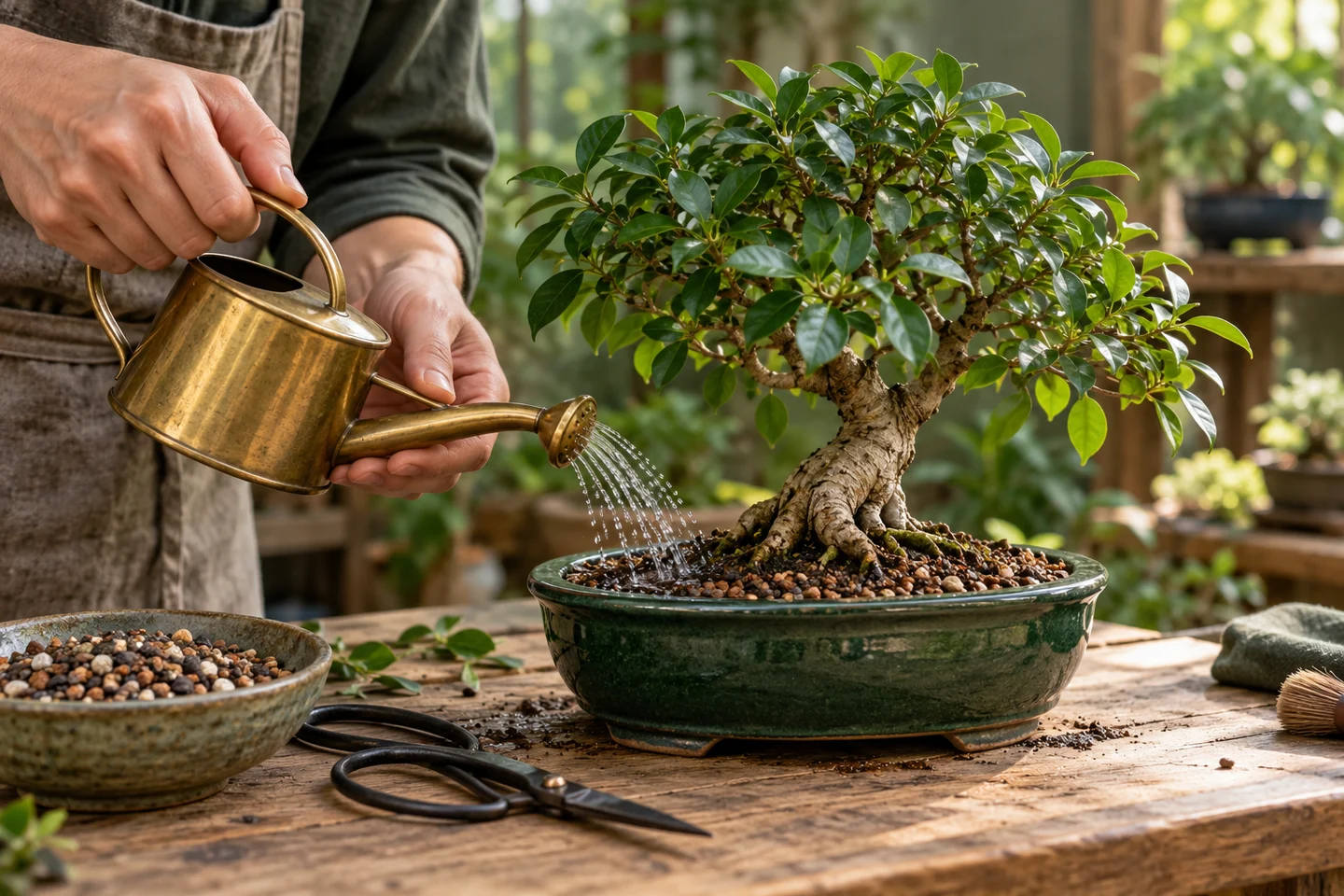
Pumice and lava are porous mineral particles used in many mixes. Akadama is a clay-based granular material that can retain water and gradually break down. Bark and other suitable organic components can change moisture retention. Particle behaviour varies with grade and quality.
Kanuma is commonly associated with acid-loving azalea culture. Do not choose an ingredient because its name sounds specialist; choose it for a clear purpose and confirm the needs of your species.
03
Particle size should suit the tree and pot
Very fine particles can pack tightly and reduce useful air spaces. Extremely large particles can leave small roots with an uneven moisture environment. Pot depth, root development and watering technique all influence the result.
Screening dusty material can help create a more consistent mix. Handle dusty substrates sensibly, follow product safety information and avoid breathing the dust.
04
Adapt a mix rather than copying a universal ratio
A grower in hot wind may need different retention from someone using the same species in a cool sheltered setting. Young development trees and refined trees in shallow pots can also need different arrangements.
Start from a reputable species-appropriate mix, observe the drying behaviour and make measured changes at a suitable repotting time. Repeated emergency changes are more disruptive than a considered adjustment.
05
Observe when the structure stops working
Water pooling on the surface, compaction, root congestion and a marked change in drying can justify an inspection. These clues do not prove that the tree needs immediate aggressive root work; they tell you to investigate.
Do not repot a weak tree solely because a bag claims to be the perfect mix. Consider timing, root condition and recovery conditions before disturbing it.
06
Buy with the label and storage in mind
Check the ingredient list, particle grade, volume and intended use. A product sold as “bonsai soil” may be mainly fine compost, while a specialist mineral mix may need a more attentive watering routine. Neither label decides suitability by itself.
Store unused material dry and clean, and keep a note of what went into each pot. Our bonsai soil buying guide provides a comparison checklist.